Unsafe at MIT: A Chronicle of a Campus War on the Jews
Reviewed by Jaime Herndon · Book by Yossi Sheffi

Review
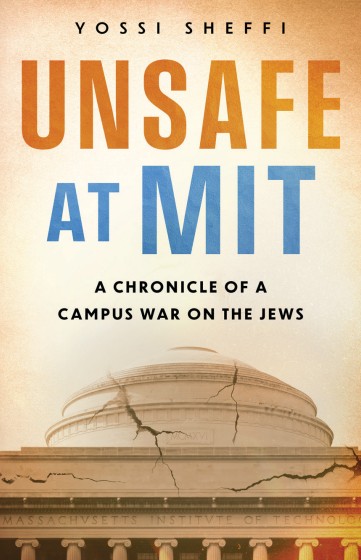
Unsafe at MIT: A Chronicle of a Campus War on the Jews
Author
Yossi Sheffi
 Jaime Herndon
The events of October 7, as well as the aftermath in the United States, changed the higher education environment—perhaps irrevocably. Yossi Sheffi, a professor of engineering at Massachusetts Institute of Technology (MIT), arguably one of the top universities in the country, knows these changes firsthand. Sheffi is Israeli and Jewish, and his newest book, Unsafe at MIT: A Chronicle of a Campus War on the Jews, is case study, memoir, and immersive reportage, all wrapped up into a damning account of the institution.
Sheffi compiled the experiences of Jews and Israelis on MIT’s campus post-October 7, 2023. He used interviews with students, post-docs, and faculty members in addition to his own experiences to get a fuller picture. In the prologue, he lists several themes that the book contains, including documenting how the administration failed to protect a minority group; the failure of MIT’s diversity, equity, and inclusion (DEI) program to extend to Jews and Israelis; and the acceptance of the incorrect binary of oppressor/oppressed. In addition, he explores the devastating realization among Israeli students that antisemitism is deeply established in Western societies, when they had expected a more rational and intellectual approach. However, in the face of rampant antisemitism and MIT’s failure to act against it, Sheffi also documents responses of Jews at MIT; how they came together and developed programs and initiatives to push back against antisemitism and anti-Israel sentiments.
Prior to October 7, MIT was unlike many other college campuses because it was not highly involved in activism. Sheffi writes, “If anything, many had found MIT to be refreshingly apolitical when they first arrived. Aside from some efforts to get the university to divest from fossil fuels and the occasional volley of Socialist rhetoric from the Graduate Student Union, the campus was almost aggressively unconcerned with current events.”
That would soon change. Prior to then, it was an anomaly for any professor to include politics in their classes—post-October 7, it became normalized.
The book unfolds almost like a documentary, with the morning of October 7, then a few days later, and a few days after that, and so forth. Sheffi’s writing style is concise and matter-of-fact, documenting events interspersed with reports from interviews, while also providing commentary on the institutional response. In perhaps the most telling line of the book that encompasses the entire campus situation, Sheffi writes, “MIT had long prided itself on neutrality in political matters, a position that, in practice, meant the institution had never developed the infrastructure to respond to this kind of pointed targeting. . . . the administration chose the language of general community welfare, which fit the situation poorly.” (p. 25).
He takes the reader to campus lectures, to the press conference before that infamous congressional hearing with college presidents, including MIT’s Sally Kornbluth, and to campus galas. We are privy to sentiments from group chats of Jewish students, ground zero of the encampments, and the daily macro- and microaggressions Jewish and Israeli students faced nearly every single day. The emotional strain is right at the surface; at times it can be hard to read in large amounts. But Sheffi doesn’t let emotion override the narrative; rather, the plainly told writing evokes emotion in the reader because of its starkness.
The book spans the academic 2023-24 school year, ending with graduation. The “aftermath” section touches on the 2024-25 school year, illustrating how MIT’s failure to act or enforce consequences had devastating effects on Jewish and Israeli students, with many abandoning their studies and/or leaving MIT. Sheffi’s book is an account of how one of the most respected institutions in the United States lost its soul, with real consequences that affected real people.
However, the most important line lies in the conclusion, and I fear it will be overlooked by readers. It is something that the Jewish community as a whole should take to heart: “I have come to believe that antisemitism is not what we have always understood it to be. It is not a problem of education, correctable through Holocaust curricula, or better Israel advocacy. It is ... a psychological reflex to resent people who refuse to subordinate their identity or their values.”
He points out that antisemitism has always been a warning sign that a society is in danger of abandoning its values, and that it cannot be solely up to Jews to address antisemitism. Whether his warnings are heeded remains to be seen.
About the reviewer
Jaime Herndon