The Wolf Shall Dwell with the Lamb: A Million Little Stories Behind Israel's Birth
Reviewed by Arnon Z. Shorr · Book by Emmet Hirsch

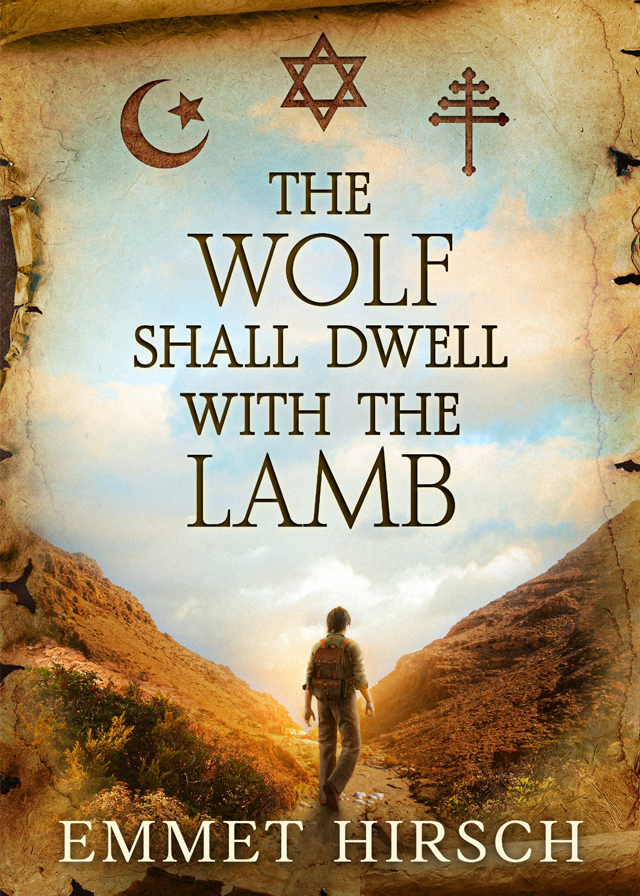
Review
The Wolf Shall Dwell with the Lamb: A Million Little Stories Behind Israel's Birth
Author
Emmet Hirsch
 Arnon Z. Shorr
Although the formation of the State of Israel remains as relevant to our world as it was nearly eighty years ago, for most people, it's a dry piece of history, an assemblage of facts (or, sadly, falsehoods) called upon—when convenient—to support or refute some current issue. It's easy to forget (or to never have known in the first place) that the birth of the modern Jewish state was not just a historical milestone, but a confluence of a million little stories, some tragic, some not, all human. Emmet Hirsch's new novel, THE WOLF SHALL DWELL WITH THE LAMB, attempts to bring—by means of fiction—some of that humanity back into our understanding of the history.
Hirsch crafts a sweeping tale about a Lebanese Jew named Joseph, and his journey from an idyllic childhood with his mother, through a turbulent adolescence as an orphan in a convent, to refugee, freedom fighter and spy for the nascent Jewish state. The book is written effectively and affectingly in the first person, as if by an elderly Joseph, recalling the many twists and turns of his long life. The drama is gripping, and the characters are defined and dimensional. But perhaps the book's strongest quality is that Hirsch's painstaking research into the history and its people serves as an effective backdrop to the story without overwhelming it. The historical context is embedded and organic, allowing the book to remain—all the way through—a fun, exciting read.
And Hirsch's treatment of that history is nuanced and fair. He doesn't paint Israel with a simple, single-hued brushstroke. He acknowledges the messiness of the formation of the state, and the continued messiness of preserving it. But all through the story, there remains a sense of optimism, channeled through Joseph, that the State of Israel is ultimately something good, ethical, moral and just. For Joseph, fighting for Israel doesn't just mean taking down terrorists or enemy fighters, it also means taking down Jews whose actions would jeopardize the kind of country Joseph wants Israel to become.
As is the case with any author who writes within a specific piece of history, Hirsch grapples with an impossible challenge: where do you draw the line between what you make up, and what you know to be true? In other words, in historical fiction, how do you balance the historical and the fiction? In his Author's Note at the end of the book, Hirsch begins, “The Wolf Shall Dwell with the Lamb is a work of fiction.” And this, perhaps, is the book's unavoidable weak spot. Throughout the incredible story, I found myself wishing that Joseph was real, and that his adventures were true. Especially now, when so many lies and half-truths are circulated about Israel and Israelis, and when even the truth seems muddy and polluted by politics and greed, I wanted desperately to be able to point to a real Israeli hero who stood and fought for an idealized Israel—the Israel I learned about as a child, that my parents and grandparents fought for. Hirsch's Author's Note goes on to explain that the events in the story are all based on or inspired by events in the historical record. But even with that careful adherence to history, I couldn't shake the disappointment that—in real life—Joseph, the hero, remains elusive.
About the reviewer
Arnon Z. Shorr